

Learn
What connects a war in the Middle East with major threats to Australia’s ocean systems?
25th March 2026
The Iran-Qatar conflict is driving expanded Australian offshore gas extraction that threatens pristine marine environments
2 minute read.
Article authored by Mindful Money Research lead and Co-CEO Kate Vennell
Attacks on 19 March 2026 by Iran knocked out 17% of Qatar's liquefied natural gas (LNG) export capacity. Qatar is one of the major producers of LNG along with the USA and Australia. In the short-term, users of gas may buy more gas from Australia which has huge deposits of LNG – most under the seabed in deep offshore waters. But much of Australia’s gas comes from pristine ocean environments. The expansion of extraction could cause devastating harm to these fragile ecosystems.
The world would not be in a situation of such dependence on imported gas, if we had done more to accelerate the transition away from fossil fuels. Too many global users including households, manufacturers and commercial properties still have systems which rely on gas (a ‘fossil fuel’ created by dead plants and animals millions of years ago). But good, renewable energy alternatives exist. When combined with rapid innovation in efficient technology, it is now very attractive for homes, offices and factories to switch to clean systems using locally generated electricity.
Burning LNG produces heat-trapping emissions of carbon dioxide (CO2) and methane. Our oceans become warmer and more acidic. Events like mass bleaching of coral and toxic algal blooms become more common. Extracting gas from the deep ocean also causes direct damage to marine systems.
Two major companies Woodside Energy and Santos are aggressively expanding production of offshore LNG - despite strong opposition from many Australians.
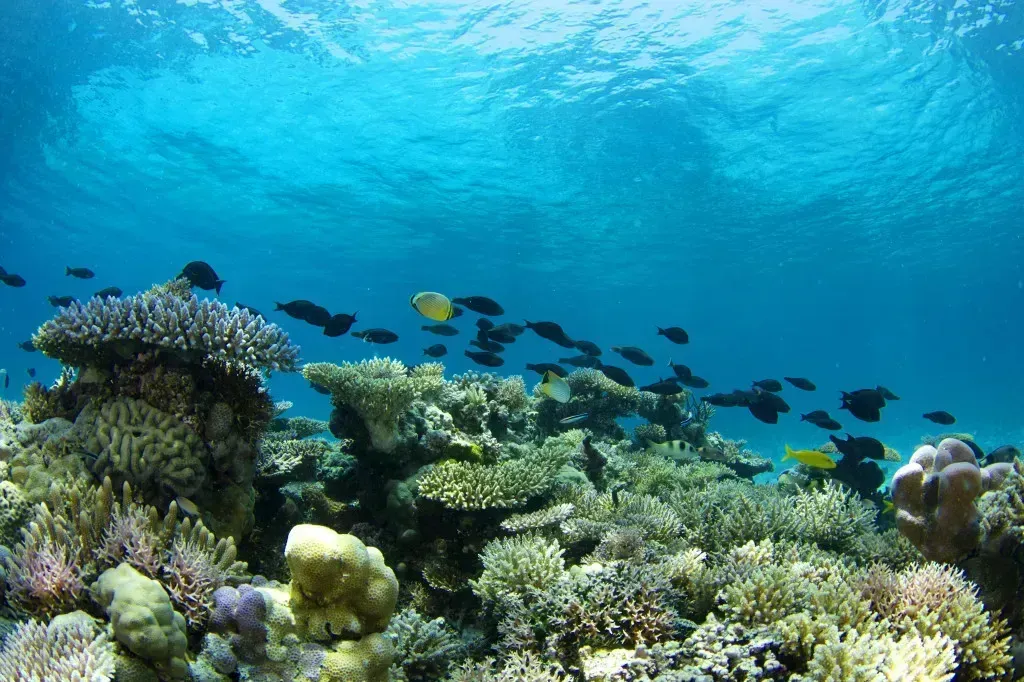
Woodside Energy gained approval in 2025 to develop the Burrup Hub fields around the North-West coast of Australia including near the exceptionally rich Scott Reef. This marine environment is home to whales, dolphins, turtles, diverse corals and marine life. Woodside will dredge the sea floor to lay the 430km pipeline and then dump dredged sediment across pristine areas.
Santos completed development of the Barossa LNG Field in the Timor Sea in early 2026. They used seismic blasting to create wells - disrupting the ability of whales and dolphins to navigate and feed. The 300km undersea pipeline connecting the field to Darwin was cut through the Oceanic Shoals Marine Park disturbing the seabed. Operations also have risks of chemical and gas leaks.
Gas from projects will produce over a billion tonnes of CO2 emissions as it is used. Researchers at Melbourne University estimate one of Woodside’s Burrup Hub projects (Scarborough) on its own will produce 49% of Australia’s entire annual CO2 emissions budget by 2049. Critics call these extremely high levels of emissions ‘carbon bombs’ - imperilling global attempts to maintain a liveable planet.
Shares in Woodside and Santos are traded in the Australian stock market. KiwiSaver funds hold $150m of shares in these companies - providing finance to support LNG expansion and ocean harm. Expansion strategies may not even be good for shareholders. In Feb 2026, the Australian Centre for Corporate Responsibility (ACCR) assessed Woodside’s expansion had eroded $3.5bn in value due to the high costs of development. Although share prices in both companies have risen due to the war when peace returns (sooner or later) gains could fall away.
Fund Managers in NZ have invested over $10bn in Fossil Fuel Companies including gas on behalf of kiwi investors. But the business model of fossil fuel and gas producers is threatened by ‘the age of electricity’ (announced by the IEA in October 2025) and alternatives such as solar and wind energy. As a result of the energy crisis, global energy users will seek to secure low cost energy and to become resilient to geopolitical shocks. South Australia is a great example of a region that has created energy security through strong ambition for clean energy. A programme of strong investment has put it on track to achieve 100% renewable electricity by 2030. This is part of a global trend, which will cause the need for fossil fuels and LNG to fall over the next two decades. As this happens, producers will have to write off the value of remaining gas in undersea fields. Share prices will fall permanently.
You can use the Mindful Money Fund Checker to see if your fund invests in these companies and other fossil fuel providers. You can tell your fund provider you don’t want Woodside, Santos or other fossil fuel companies in your investment fund. You can find a fund that doesn’t invest in fossil fuel and gas companies. Make your Savings Gas and Fossil Fuel Free.
Ready to Align your Investments with your Ocean Values?
Join the ‘Let our Ocean Breathe’ Campaign! Find out about more simple actions you can take to let our ocean breathe.
Your KiwiSaver and managed fund investments can be channeled away from companies causing ocean harm to investments that protect our oceans. Mindful Money's Fund Finder makes it simple and free to discover funds that match your values. Most providers don't charge switching fees, and research consistently shows ethical funds deliver returns that match or exceed traditional options. Your money can protect our oceans while protecting your financial future.
We welcome you to pass this on! The more informed we are, the better decisions we can make towards protecting our beautiful ocean for the future. Use the power of your networks and share this with your friends, family and ocean loving community.
The negative impact of fossil fuels is just one of the topics covered in Mindful Money’s report ‘Let our Oceans Breathe’ which outlines how investment in certain sectors and companies threatens our oceans.
Scott Reef Image used with permission from Australian Institute of Marine Science.
West Atlas Oil Spill Image By Chris Twomey - Office of Senator Rachel Siewert ([1]), CC BY-SA 2.5 au